


Μάρτυς Κυρίου Dice Set
$467.00
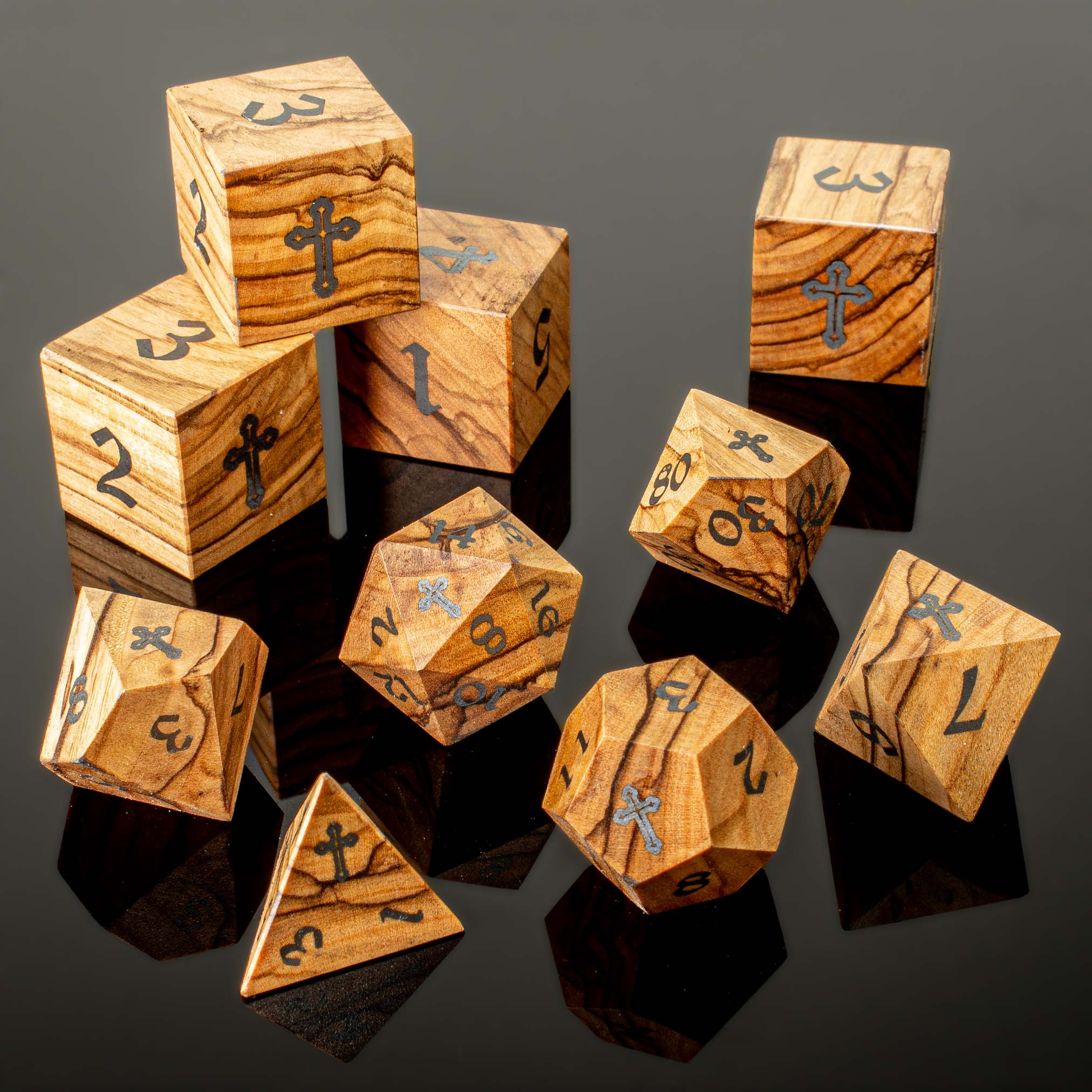
The Μάρτυς Κυρίου Dice set witnessed the most influential life in human history, bridging the gap between ancient manuscript, archeology, and physical artifact. Crafted from sustainably sourced prunings from the olive groves in Bethlehem whose trees are over 2000 years old and date to the time Jesus of Nazareth walked the earth. Each face is inlaid in iron and each die features and iron cross on the highest number. The suede lined black walnut box is emblazoned with an iron inlaid crown of thorns.
Only 2 left in stock
-
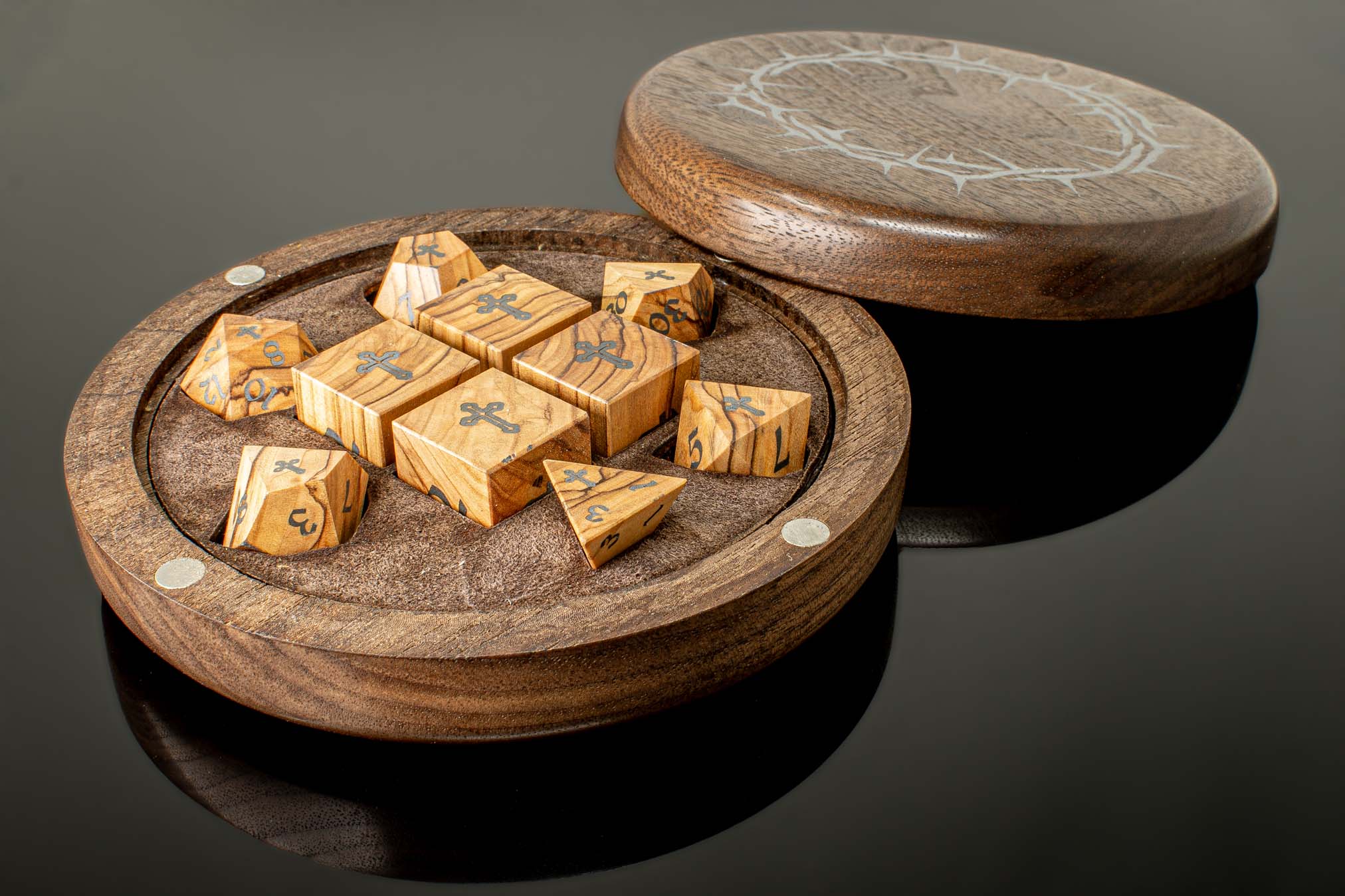
History is usually written on parchment or carved into stone, but rarely is it found still pulsing with the slow, ancient life of a tree. The Μάρτυς Κυρίου (Martys Kyriou) dice set is crafted from Bethlehem Olive wood pruned from trees whose age and location date back over two millennia. These are not merely tabletop dice; they are fragments of a living witness to 1st-century Judea.
The name Μάρτυς Κυρίου has a double meaning. Directly translated from Ancient Greek, it means Witness of the Lord, for these trees bore witness to the birth of the most influential man to ever walk the face of the earth. Μάρτυς (martyr) means Witness. It is the etymological root of the English word “martyr,” signifying a testimony so profound it transcends time. The Μάρτυς Κυρίου set is piece of that testimony. It is a tribute to the man who divided history into Before and After, contained within wood hewn from the very trees that watched him do it.
While many debate the Deity of Christ, the case for the historical man and the events surround His life and death are engrained in the historical and archeological record. When judging the validity of historical figures historians look for contemporary authors from within 100 – 150 years of the subject’s life. Authors writing closer to the time period of the figure are typically considered more substantial than later writings. Historians also look at the number of contemporary copies of those writings. We can look at the contemporaries of Jesus of Nazareth to get a sense of how the historical record stacks up.

Documented History
| Comparison Metric | Tiberius (Emperor) | Jesus of Nazareth |
| Status in 30 AD | Ruler of the Roman Empire | Itinerant Teacher in Judea |
| Contemporary Sources | ~4-5 Authors | ~10+ Authors |
| Sources within 150 yrs | ~10 Total | 40+ Total |
| Manuscript Count | Dozens (Later copies) | Thousands (Early Copies) |
Just by the numbers you begin to see that their 1st century contemporaries considered Jesus to be of more interest than the sitting Roman Emperor, Tiberius. Even if we limit ourselves to just extra biblical hostile and secular authors, we see that the record contains nearly double the number of authors that wrote about Tiberius.
Jesus of Nazareth
-
Thallus (Historian, ~52 AD): An early secular account documenting the mid-day darkness at the Passion.
-
Mara Bar-Serapion (Stoic Philosopher, ~73 AD): Refers to the “Wise King” whose “new law” outlived his executioners.
-
Josephus (Romano-Jewish Scholar, ~93 AD): Records the “wise man” known for his “startling deeds” in Judea.
-
Pliny the Younger (Roman Governor, ~112 AD): Describes early followers singing hymns to “Christus” as if to a god.
-
Tacitus (Roman Senator, ~116 AD): Formally documents the “extreme penalty” carried out under Pontius Pilate.
-
Suetonius (Imperial Archivist, ~121 AD): Records imperial decrees caused by disturbances over “Chrestus.”
-
Phlegon (Greek Chronicler, ~140 AD): Notes a massive earthquake and solar darkness during Tiberius’s reign.
-
Lucian (Greek Satirist, ~165 AD): Confirms the historical reality of the “man crucified in Palestine.”
-
The Talmud (Jewish Tradition, ~70–200 AD): Documents the execution of “Yeshu” on the eve of Passover.
-
Celsus (Platonic Philosopher, ~177 AD): An early critic who confirms the life, Egyptian travels, and death of Jesus.
Emperor Tiberius
-
Velleius Paterculus (Roman Soldier, ~30 AD): A contemporary military history written during the Emperor’s life.
-
Valerius Maximus (Rhetorician, ~30 AD): A collection of biographical anecdotes dedicated to Tiberius.
-
Philo (Jewish Philosopher, ~40 AD): Diplomatic and political records from the early 1st century.
-
Seneca the Elder (Teacher, ~40 AD): Rhetorical observations of the Roman state during the reign.
-
Pliny the Elder (Naturalist, ~77 AD): Brief historical references found in his Natural History.
-
Tacitus (Roman Senator, ~116 AD): A detailed retrospective biography found in the Annals.
-
Suetonius (Imperial Archivist, ~121 AD): A full administrative biography in The Twelve Caesars.
Historical Conclusion
The math of the historical evidence is clear even when we leave out his followers: Within 150 years of their lives, the carpenter from Nazareth was documented by more than twice the number of independent, secular voices as the Emperor of the Roman Empire.
Even if we look at the MOST famous Roman emperor, Julius Caesar, while significant by ancient standards, the manuscript evidence is dwarfed when placed alongside the historical record of Jesus of Nazareth. Even when aggregating every major historical reference to Caesar the total Greek manuscript count is less than 500, with many depending on a THOUSAND YEAR GAP between the life of Caesar and the earliest surviving copies. By contrast, the documentation for Jesus is unparalleled, boasting over 5,800 Greek manuscripts and more than 20,000 total versions across various ancient languages, with the earliest documents appearing within mere decades of the events of Jesus’s life themselves. This staggering disparity in the historical paper trail shows without a doubt Jesus of Nazareth is the most thoroughly recorded individual in the history of the ancient world. But this doesn’t even take in to account the archeological record.
Archaeological Finds
-
The Pilate Stone (Found 1961): A limestone block discovered in the ruins of Caesarea Maritima bearing a Latin inscription of Pontius Pilate, Prefect of Judea. It provides the forensic proof of the man who ordered the “extreme penalty” recorded by Tacitus.
-
The Yehohanan Heel Bone (Found 1968): The only physical evidence of a Roman crucifixion ever discovered—a 1st-century heel bone still pierced by a 7-inch iron nail. This find confirms the brutal reality of the Roman execution method and makes the case for the use of iron inlays in this set.
-
The Caiaphas Ossuary (Found 1990): An intricately carved limestone bone box inscribed with the name of Joseph, son of Caiaphas. It confirms the existence and burial site of the High Priest who presided over the trial of the “Man from Nazareth.”
-
The Nazareth House (Found 2009): Archaeologists unearthed a 1st-century courtyard house in Nazareth, proving that the “backwater” village described in the ancient manuscripts was a real, inhabited settlement during the 1st century.
-
The Pool of Siloam (Found 2004): The discovery of this massive ritual pool in Jerusalem confirmed the accuracy of 1st-century geographical descriptions and the complex religious infrastructure of the city during the Second Temple period.
-
The Magdala Stone (Found 2009): A carved stone found in a 1st-century synagogue in Magdala, featuring the oldest known carved image of the Second Temple’s Menorah, grounding the “startling deeds” of the era in a specific, physical location.
-
The Church of the Nativity Grotto (Bethlehem): While the church above was built in the 4th century, it is anchored over a 1st-century limestone grotto—the traditional site of the Nativity and the very soil where our Bethlehem Olive wood took root two thousand years ago.
Archaeological Conclusion

The history of the 1st century is no longer a matter of mere tradition; it is an archaeological reality etched into the stone, bone, and iron of ancient Judea. From the Pilate Stone in Caesarea to the Yehohanan bone in Jerusalem, archaeology has provided the material anchors for a life once thought to exist only in ink and parchment. The Μάρτυς Κυρίου set is a material witness this excavated truth and the written record. By marrying 2,000-year-old Bethlehem olive wood with the iron that defined Roman authority, this dice set that mirrors the very artifacts being unearthed in the hills of Judea today. It is a physical testimony that the most influential man to ever walk the earth left metaphorical footprints that remains visible in the dirt, the stone, and the wood of the world he split into the before and after. A.D. and B.C.
The Convergence of Evidence
The Μάρτυς Κυρίου set is where the ink, stone, iron and bone ancient world finally meet. Western society has spent two thousand years debating the philosophy and the divinity of the man from Nazareth, but the historic and archeologic reality is settled: he walked the earth, he changed the map, he split the timeline itself, and he left a paper trail that outshines the greatest emperors of Rome.
When you hold these dice, you are holding the convergence of that evidence. Bethlehem Olive wood isn’t just a material; it is a living contemporary that breathed the same air as the man himself. The Iron isn’t just an inlay; it is a tactile reminder of the Roman authority that tried and failed to contain his influence. And the Black Walnut Reliquary, crowned in thorns, is a sanctuary for a set of dice that represents the most documented life in human history.
This isn’t just a tool for your next campaign. It is an artifact for your collection. Whether you are a student of history, a collector of the rare, or a seeker of the sacred, the Μάρτυς Κυρίου offers something truly unique: the chance to hold the weight of an epoch in your hands.
Reviews
Dice Weight (1d20)
Material Density
Material Hardness
Country of Origin
Material Color
Lifetime Warranty
Enjoy the peace of mind of knowing your investment is covered under our lifetime warranty.
Made In Texas
Our dice are made in our state of the art facilities in Dallas, Texas by skilled craftsmen using the finest materials available.
Lifetime Warranty
We understand that you value your dice collection. We do too. That’s why all of our dice are covered under our lifetme warranty.
Experience Premium
Handcrafted for the discerning gamer. Our dice are crafted from premium materials with luxurious craftsmanship.


There are no reviews yet.