


Papyrus D20
Composites
$36.00
These dice are crafted from layered papyrus and engraved with the Hieratic script. An ancient Egyptian script developed for use specifically on papyrus. Hieratic was Egypt’s everyday utility script used by scribes and priests to create millions of papyrus documents some of which survive today to give us a peek into ancient history.
Lifetime guarantee: we’ll repair or replace it free, no questions asked. Just return it in its original box or tin, and you only pay to ship it to us.
- Free US shipping over $200
- Handmade in Texas
Description
Hieratic: the handwritten script of papyrus
Egypt did not use one script for everything. Hieroglyphs, the familiar pictographs, belonged on stone: temple walls, tombs, stelae, and other work meant to adorn public works. Day-to-day writing was different. Accounts, letters, legal notes, medical recipes, literature, and mathematics went down in hieratic, a cursive Egyptian script made for speed on the technological innovation of papyrus.
Papyrus began as a marsh plant of the Nile, *Cyperus papyrus*, thick in the Delta and along the river’s wet margins. Egyptians cut the triangular stalks, sliced the soft inner pith into thin strips, and laid those strips in two layers at right angles. Pressed and dried, the sap of the plant acted like a glue and bound the fibers into a sheet. No loom, no pulp vat, just plant, pressure, and time. The result was flexible sheet light, portable, and strong enough to roll, while smooth enough for a reed brush to lay down carbon ink. From at least the early third millennium BCE it was Egypt’s everyday writing surface: accounts, letters, law, medicine, literature, and mathematics all rode those rolls.
All those writings were in Hieratic, which comes from the Greek hieratiká, meaning “priestly writing”. Clement of Alexandria used it in the second century CE, long after the hand had already spent most of its life as ordinary scribal writing. In practice, students learned hieratic first, and then Hieroglyphs came in their advanced classes.
Hieratic grew out of hieroglyphic writing in the late Predynastic / Early Dynastic period, roughly the turn of the third millennium BCE, as ink and reed met papyrus, wood, leather, and pottery ostraca. Hieratic reads right to left. Early on it could run in columns or lines but after the Middle Kingdom, right to left horizontal lines became the norm. The signs are ligatured and simplified: brushwork, not carved outlines. Over the centuries the script split into a quick administrative cursive and a clearer version for literary and religious scrolls.
The technology of reed and ink on papyrus let a scribe write as fast as the work demanded. That is why almost every surviving Egyptian mathematical text, including the Rhind Mathematical Papyrus and the Moscow Mathematical Papyrus, is hieratic on papyrus, not hieroglyphs on stone. Hieratic remained the main everyday script for well over two thousand years. Around the mid-first millennium BCE, Demotic, a later and even more cursive northern hand, took over most mundane writing. Hieratic lived on chiefly in priestly and literary use into the Roman period.
Hieratic numerals
The numbers on this die follow that script. Hieratic numerals are ciphered, but there is no zero. They have different signs for each single digit 1 - 9 and each tens digit 10 - 90. 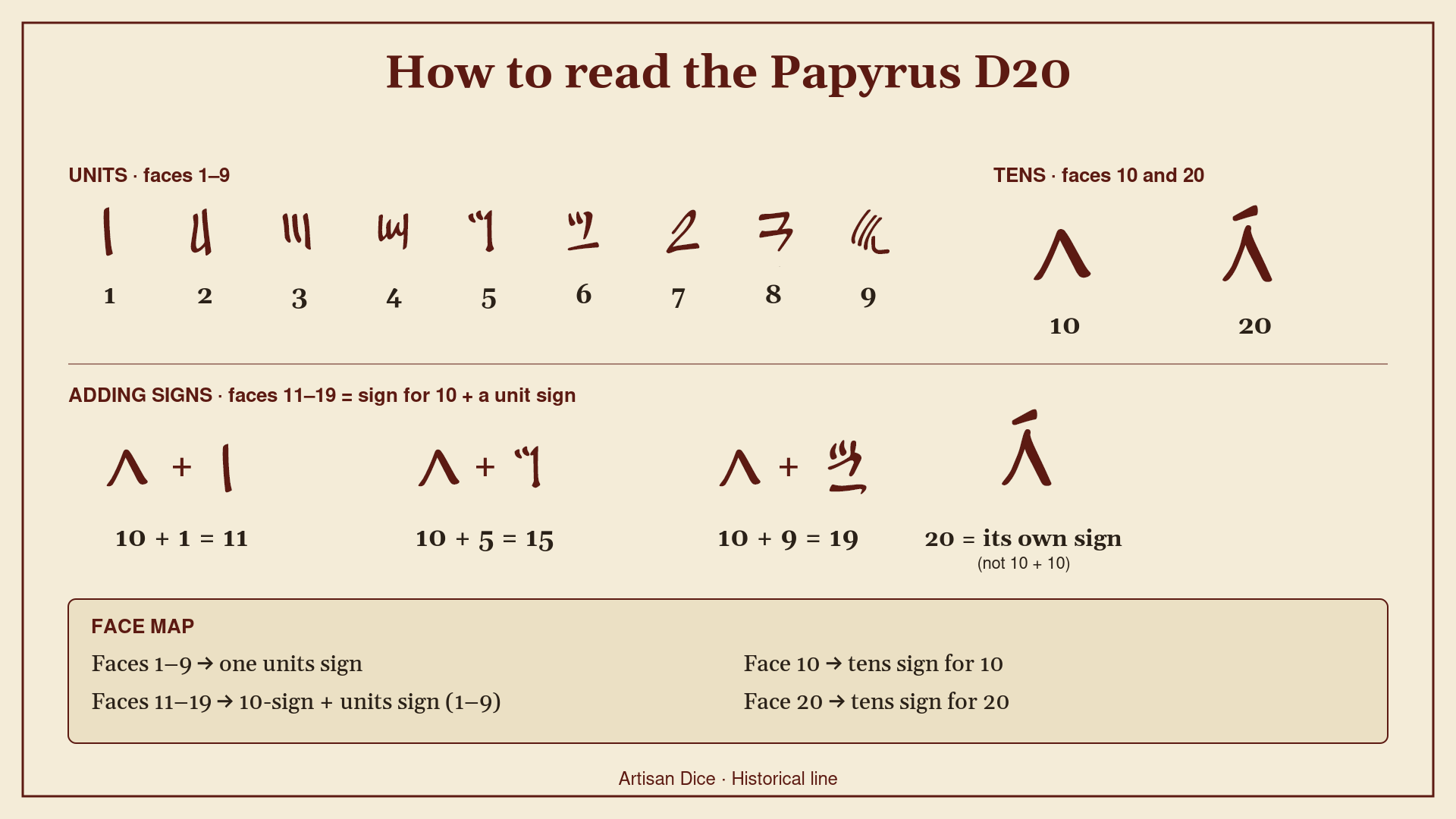
That sets this die apart from the rest of our Egyptian Historical pieces. The Demotic Icosahedron carries the names of gods in Demotic script. The Ptolemaic d20 follows the Met’s Greek-and-Coptic lettering. The Papyrus D20 is about the numbers themselves: the counting system written for papyrus, engraved on our 3/4 inch scale d20 machined from a composite papyrus blank featuring 100 layers of papyrus and epoxy resin.
Details
- Material
- Composites
- SKU
- PAP-D20
Shipping & lead time
Ready to ship: ships in 1–2 business days (we don’t ship weekends or US holidays). Made to order: 3–6 weeks.
Guaranteed for Life
Everything Artisan Dice makes is guaranteed for life, no questions asked. If it ever chips, cracks or breaks, we’ll repair or replace it free. Just return it in its original box or tin; you only pay to ship it to us.
Care
Roll them like you stole them. They're Guaranteed for Life. If one ever breaks, send it back in its original box or tin and we'll repair or replace it free.
Made in our Dallas, TX workshop by skilled craftsmen using the finest materials available.
Lifetime guarantee: we’ll repair or replace it free, no questions asked. Just return it in its original box or tin, and you only pay to ship it to us.
Handcrafted for the discerning gamer, from premium materials.
Reviews
No reviews yet
You may also like


Reviews